
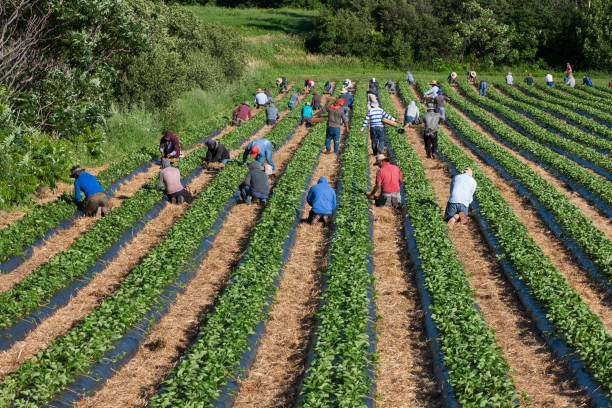
Canada’s agricultural industry continues to create employment opportunities for workers in farming, livestock, harvesting, greenhouse production, fruit and vegetable cultivation, dairy operations and other agricultural activities.
For foreigners searching for farm worker jobs in Canada with visa sponsorship, agriculture can be an important option, particularly for applicants who do not have a university degree or professional qualification.
Canada has specific programs that allow eligible employers to hire temporary foreign agricultural workers. Depending on the worker’s nationality, occupation and employer, the available route may include the Seasonal Agricultural Worker Program (SAWP) or another agricultural stream under Canada’s Temporary Foreign Worker Program.
For workers recruited through the agricultural stream, the employer may need a positive Labour Market Impact Assessment (LMIA) before the worker applies for an employer-specific work permit.
Current Canadian Job Bank data also shows that agricultural work can provide meaningful earnings. For example, livestock labourers have a national median wage of $20 per hour, while harvesting and grain farm workers have a national median of approximately $18 per hour.
If you are considering moving to Canada as a foreign agricultural worker, this guide explains the available farm jobs, salaries, visa sponsorship process, LMIA requirements, documents, application steps and potential pathways toward permanent residence.
What Are Farm Worker Jobs in Canada?
Farm worker jobs involve supporting agricultural production and can be found on farms, greenhouses, orchards, livestock operations, nurseries and other agricultural businesses.
Depending on the employer, duties may include:
- Planting crops
- Harvesting fruits and vegetables
- Feeding livestock
- Cleaning animal facilities
- Operating agricultural equipment
- Irrigation
- Sorting and packing produce
- Greenhouse maintenance
- Weeding
- Pruning
- Loading agricultural products
- Maintaining farm buildings
- Cleaning equipment
- Assisting with animal health programs
Many entry-level agricultural occupations do not require a university degree.
For example, Canada’s Job Bank states that harvesting labourers generally require on-the-job training and usually require short-term work experience with no formal education.
This makes agriculture one of the areas worth considering for foreigners who have practical experience but limited formal education.
Types of Farm Worker Jobs Available in Canada
There is no single type of farm worker position. Canadian agricultural employers recruit workers for several different areas.
1. General Farm Worker
General farm workers can assist with several aspects of agricultural production.
Typical duties include:
- Planting
- Harvesting
- Irrigation
- Feeding animals
- Cleaning
- Packing
- Loading
- Equipment maintenance
This is one of the broadest categories for people searching for farm jobs in Canada for foreigners.
2. Fruit Picker and Harvesting Worker
Fruit and crop harvesting workers can work on:
- Apple farms
- Berry farms
- Grape farms
- Vegetable farms
- Orchards
- Specialty crop farms
Duties can involve picking, sorting, grading and packing agricultural products.
Job Bank currently reports a national median wage of approximately $18 per hour for harvesting labourers, with published national wages ranging from $16 to $25 per hour.
3. Dairy Farm Worker
Dairy farm workers assist with cattle and milk production.
Duties can include:
- Feeding cattle
- Cleaning barns
- Milking assistance
- Animal monitoring
- Maintaining equipment
- Supporting breeding programs
- General farm maintenance
Job Bank currently lists a $20 per hour national median wage for livestock labourers, with a national range of approximately $15 to $28 per hour.
4. Livestock Farm Worker
Livestock workers may work with:
- Cattle
- Pigs
- Poultry
- Sheep
- Other farm animals
Their duties can involve feeding, cleaning, animal care and assisting with production programs.
This occupation generally relies heavily on practical experience and on-the-job training.
5. Greenhouse Worker
Greenhouses and nurseries employ workers to assist with:
- Planting
- Watering
- Pruning
- Transplanting
- Plant maintenance
- Harvesting
- Packaging
Greenhouse work can provide opportunities in different parts of Canada, depending on the crop and employer.
6. Vegetable Farm Worker
Vegetable farms may recruit workers for:
- Planting
- Weeding
- Harvesting
- Sorting
- Washing
- Packaging
- Loading
These positions can be seasonal or longer term depending on the employer’s production cycle.
7. Grain Farm Worker
Grain farming is particularly important in Canada’s prairie provinces.
Workers may assist with:
- Seeding
- Crop maintenance
- Harvesting
- Grain handling
- Equipment cleaning
- Storage
- General farm duties
Job Bank currently reports a national median wage of $18 per hour for grain farm workers, with Saskatchewan showing a median of approximately $26 per hour in its published data.
8. Poultry Farm Worker
Poultry workers may assist with:
- Feeding
- Cleaning
- Egg collection
- Animal care
- Barn maintenance
- Production activities
Experience in poultry production can be useful, although some employers provide on-the-job training.
Farm Worker Salary in Canada
Farm worker salaries vary according to occupation, province, employer, experience and whether the position is seasonal or permanent.
| Farm Job | Approximate National Median | Published National Range |
|---|---|---|
| Livestock labourer | $20/hour | $15–$28/hour |
| Harvesting labourer | $18/hour | $16–$25/hour |
| Grain farm worker | $18/hour | $16–$25/hour |
| Fruit farm worker | $18/hour | $16–$25/hour |
These are Job Bank wage figures rather than guaranteed salaries. Actual compensation can be different depending on the employer and location.
Some provinces can offer considerably higher wages for particular agricultural occupations.
For example, Job Bank’s current figures show a median of $26 per hour for grain farm workers in Saskatchewan, compared with $18 nationally.
This demonstrates why foreign workers should research the specific province and job rather than relying only on a national average.
What Is Farm Worker Visa Sponsorship in Canada?
The phrase “visa sponsorship” is commonly used by international job seekers, but Canada does not operate one general “farm worker sponsorship visa.”
Instead, an agricultural employer may hire a foreign worker through an applicable immigration program.
One important route is the Temporary Foreign Worker Program (TFWP).
Under Canada’s agricultural stream, employers can hire temporary foreign workers when Canadian citizens and permanent residents are not available, provided the employer and position meet the applicable requirements.
Where an LMIA is required, the employer applies for the LMIA.
The foreign worker then uses the required employer documentation to apply for the appropriate work permit.
What Is an LMIA?
LMIA means Labour Market Impact Assessment.
It is a document used to assess whether hiring a temporary foreign worker is likely to have a positive, neutral or negative impact on Canada’s labour market.
For many agricultural workers outside the Seasonal Agricultural Worker Program, the employer must obtain a positive LMIA before the worker applies for an employer-specific work permit.
Canada’s official guidance states that, for other agricultural workers, the employer must obtain a positive LMIA and provide the worker with a copy of the positive LMIA and the job offer or employment contract.
This distinction is extremely important.
A foreign worker does not simply purchase an LMIA.
The employer is responsible for the LMIA process where one is required.
Seasonal Agricultural Worker Program
The Seasonal Agricultural Worker Program (SAWP) is another important route.
However, SAWP is not available to agricultural workers from every country.
The program currently allows Canadian employers to hire temporary agricultural workers from Mexico and participating Caribbean countries for qualifying agricultural work. Workers can be employed for a maximum period of eight months between January 1 and December 15, subject to the program’s conditions.
Therefore, applicants should first determine whether their nationality is eligible.
For workers from countries that do not participate in SAWP, another agricultural work permit route may be relevant.
Who Can Apply for Farm Worker Jobs in Canada?
Potential applicants may include people with experience in:
- Crop farming
- Fruit harvesting
- Vegetable farming
- Dairy farming
- Livestock production
- Poultry farming
- Greenhouse work
- Agricultural machinery
- Farm maintenance
- Agricultural packing
A university degree is generally not required for many entry-level farm labour occupations.
For harvesting labourers, Canada’s Job Bank specifically indicates that the occupation usually requires on-the-job training and no formal education.
However, immigration requirements are separate from job requirements.
Being qualified for a farm job does not automatically mean you qualify for a Canadian work permit.
Requirements for Farm Worker Jobs With Visa Sponsorship
The exact requirements depend on the immigration program and job.
Applicants may need:
- A valid passport
- Genuine job offer
- Employment contract
- Positive LMIA where required
- Relevant work experience
- Proof of identity
- Medical examination where required
- Police certificates where required
- Biometrics
- Proof of funds where applicable
- Work permit application
- Additional documents requested by immigration authorities
The employer may also have to satisfy recruitment, wage, accommodation and working-condition requirements.
Employer Requirements for Agricultural Workers
Canadian agricultural employers using the Agricultural Stream must meet specific requirements.
The agricultural stream applies to employers whose production falls within specified commodity sectors and whose activities relate to on-farm primary agriculture.
The current national commodity list includes areas such as:
- Dairy
- Bovine
- Poultry
- Swine
- Sheep
- Fruits
- Vegetables
- Greenhouses
- Nurseries
- Grains
- Oilseeds
- Mushrooms
- Flowers
- Horses
- Maple syrup
The employer must also meet the applicable LMIA requirements.
How to Find Farm Worker Jobs in Canada
One of the safest places to begin is Canada’s official Job Bank.
Search for:
Farm worker jobs Canada
Farm jobs Canada for foreigners
Agricultural jobs Canada visa sponsorship
Fruit picker jobs Canada
Greenhouse jobs Canada
Dairy farm jobs Canada
Livestock jobs Canada
Farm worker LMIA Canada
Agricultural jobs with LMIA
Job Bank provides occupation information, wages and available vacancies.
Its current data shows more than 1,000 advertised positions for both grain/harvesting and livestock-related occupations at the time of writing.
However, applicants outside Canada must pay attention to whether the employer is actually recruiting international candidates.
Job Bank warns that most Canadian employers will not hire people who do not already have valid work authorization.
How to Apply for Farm Worker Jobs in Canada From Abroad
Step 1: Prepare Your Resume
Create a clear resume showing your:
- Farming experience
- Crops worked with
- Livestock experience
- Machinery experience
- Previous employers
- Employment dates
- Skills
- Training
- Contact information
Step 2: Search for Canadian Employers
Use Job Bank and legitimate recruitment platforms.
Search by occupation and province.
Step 3: Confirm International Recruitment
Do not assume that every farm is willing to hire overseas workers.
Look for vacancies that specifically indicate international recruitment or contact the employer directly.
Step 4: Apply for the Position
Submit your resume and any requested documents.
Step 5: Complete the Interview
The employer may conduct a telephone or video interview.
Be prepared to discuss:
- Your farming experience
- Physical work experience
- Agricultural machinery
- Availability
- Previous employers
- Ability to work in rural locations
Step 6: Receive a Genuine Job Offer
A genuine offer should clearly state the:
- Employer name
- Job title
- Wage
- Work location
- Working hours
- Start date
- Employment conditions
Step 7: Employer Completes the Required Process
Where an LMIA is required, the employer applies for it.
Canada’s agricultural LMIA process includes requirements relating to recruitment and advertising. Employers applying through the agricultural stream must generally demonstrate reasonable efforts to hire or train Canadians and permanent residents and meet the applicable advertising requirements.
Step 8: Apply for Your Work Permit
After receiving the necessary employer documentation, you apply for the appropriate work permit.
For other agricultural workers, the Canadian government specifically identifies the work permit as an employer-specific permit, meaning the worker is generally authorized to work for the employer named on the permit.
Step 9: Complete Biometrics and Other Requirements
Depending on your circumstances, you may need biometrics, medical examinations or additional documentation.
Step 10: Wait for Approval
Only travel and begin employment after receiving the appropriate authorization.
Can Farm Workers Bring Their Families to Canada?
Family options depend on the specific work permit, occupation, immigration program and current Canadian rules.
A worker should not assume that receiving a farm job automatically means that a spouse or children can receive an open work permit.
Family eligibility should be checked against the rules in force at the time of application.
Can Farm Workers Get Permanent Residence in Canada?
This is one of the most important questions for foreign agricultural workers.
A temporary farm worker permit does not automatically become permanent residence.
However, agricultural experience can potentially contribute to eligibility under certain economic immigration programs, depending on the occupation, work experience, language ability and other requirements.
Potential pathways may include:
Provincial Nominee Programs
Canadian provinces and territories operate their own immigration programs.
Some streams target workers in occupations experiencing labour shortages.
Eligibility varies by province.
Express Entry
Express Entry manages applications for several economic immigration programs.
Eligibility depends on factors including:
- Age
- Education
- Language ability
- Skilled work experience
- Canadian experience
- Other program-specific factors
Not every farm worker will qualify.
Agri-Food Immigration Pilot
Canada previously operated the Agri-Food Immigration Pilot, which provided a permanent residence pathway for certain workers in eligible industries.
Applicants should not rely on old articles advertising the pilot as currently open. Immigration programs can open, close or change, so current IRCC information should always be checked before making an application.
Provincial Agricultural Pathways
Some provinces may operate agricultural or rural immigration pathways.
These can be particularly relevant because many agricultural jobs are located outside Canada’s largest cities.
Rural Canada and Agricultural Employment
A significant portion of Canadian agricultural production occurs outside major metropolitan areas.
This makes rural communities important destinations for foreign agricultural workers.
Canada has also introduced immigration initiatives designed to support rural communities and attract workers.
However, a rural farm job does not automatically qualify someone for permanent residence.
The applicant must meet the requirements of the particular immigration program.
Important 2026 Update for Agricultural Employers
Canada introduced temporary measures for certain rural employers under the Temporary Foreign Worker Program beginning in 2026.
From April 1, 2026 to March 31, 2027, eligible employers in participating rural areas may benefit from temporary measures concerning certain low-wage positions. The measures are subject to provincial and territorial participation and other conditions.
This is particularly relevant because many agricultural businesses operate in rural areas.
However, applicants should not interpret these measures as a guarantee that a farm can sponsor any foreign worker.
The employer must still meet the applicable requirements.
Farm Worker Jobs in Canada: Provinces to Consider
Agricultural opportunities exist across Canada.
Some important agricultural regions include:
Alberta
Known for cattle, grain and other agricultural production.
Saskatchewan
A major agricultural province, particularly for grain and oilseed production.
Current Job Bank wage information shows a relatively high median wage for grain farm workers in Saskatchewan compared with the Canadian national median.
Manitoba
Important for grain, livestock and other agricultural activities.
Ontario
Offers opportunities in:
- Fruit
- Vegetables
- Greenhouses
- Dairy
- Livestock
- Specialty agriculture
British Columbia
Agricultural opportunities include:
- Fruit
- Greenhouses
- Nurseries
- Vegetables
- Specialty crops
Atlantic Provinces
New Brunswick, Nova Scotia, Prince Edward Island and Newfoundland and Labrador also have agricultural employers.
The right destination depends on the available vacancy rather than simply choosing the province with the highest advertised wage.
Documents to Prepare
Before applying, organize:
| Document | Why It May Be Needed |
|---|---|
| Passport | Identity and travel |
| Resume | Employment history |
| Job offer | Proof of employment |
| Employment contract | Job conditions |
| LMIA documentation | Where required |
| Reference letters | Work experience |
| Training certificates | Skills |
| Police certificate | Where required |
| Medical examination | Where required |
| Biometrics | Immigration processing |
| Proof of funds | Where applicable |
| Family documents | Where applicable |
Never submit false documents.
False information can lead to refusal and potentially serious immigration consequences.
Farm Worker Recruitment Agencies
Foreign workers may encounter recruitment agencies advertising Canadian farm positions.
An agency can assist with recruitment, but applicants should distinguish between:
Recruitment assistance
and
immigration representation.
A recruitment company cannot guarantee that the Canadian government will approve a work permit.
If someone claims to sell an “LMIA,” exercise extreme caution.
The legitimate process begins with a Canadian employer and an actual employment need.
How to Avoid Canada Farm Job Scams
Be careful with advertisements that promise:
“Guaranteed Canada farm job.”
“Guaranteed LMIA.”
“Pay $5,000 for sponsorship.”
“Guaranteed Canada PR.”
“No interview required.”
“Visa guaranteed.”
“Send your passport and payment today.”
Before paying anyone:
- Verify the employer.
- Find the company’s official website.
- Contact the employer independently.
- Confirm the job exists.
- Confirm the salary.
- Ask who the actual employer is.
- Ask which immigration program is being used.
- Verify the immigration information through Canada.ca.
- Never submit fake documents.
- Never assume an LMIA guarantees a work permit.
Official Websites for Canadian Farm Jobs
Job Bank Canada
Use Job Bank to search agricultural vacancies and research wages and labour market information.
Immigration, Refugees and Citizenship Canada
Use Canada’s official immigration website to check work permit requirements.
Temporary Foreign Worker Program
Temporary Foreign Worker Program
This is the official source for information about Canadian employers hiring temporary foreign workers and the LMIA process.
Frequently Asked Questions
Can foreigners get farm jobs in Canada?
Yes. Canada has programs that allow eligible employers to hire temporary foreign agricultural workers. The exact process depends on the worker’s nationality, employer, occupation and immigration category.
Do I need a degree to work on a Canadian farm?
Usually not for many entry-level farm labour positions. For example, Job Bank indicates that harvesting labourers generally require on-the-job training and no formal education.
What is the salary of a farm worker in Canada?
It depends on the occupation. Current Job Bank figures show a national median of about $18 per hour for harvesting and grain farm workers and $20 per hour for livestock labourers.
Can I get an LMIA farm job from outside Canada?
Potentially. A Canadian employer may hire eligible foreign agricultural workers through the Temporary Foreign Worker Program where the employer and position meet the requirements.
Does the employer pay for my LMIA?
The LMIA is an employer process. Be extremely cautious if a recruiter asks you to purchase an LMIA or promises to sell you one.
Can I apply for a Canadian farm job without Canadian experience?
Yes, some agricultural occupations rely on on-the-job training and do not require formal education. However, individual employers can set their own experience requirements.
Can farm work lead to PR in Canada?
Potentially, depending on your occupation, Canadian work experience, language ability and eligibility for a particular permanent residence program. A temporary work permit itself does not guarantee PR.
Can I bring my family?
Family eligibility depends on the worker’s specific immigration situation and current Canadian rules. It should be checked separately rather than assumed.
Final Thoughts
Farm worker jobs in Canada with visa sponsorship can be an attractive option for foreign workers who have agricultural experience or are willing to perform physically demanding work.
Opportunities can be found in crop farming, harvesting, livestock, dairy, poultry, greenhouses, grain production, fruit farming and vegetable production.
Current Job Bank information shows that agricultural wages can vary substantially by occupation and province. Livestock labourers have a national median of approximately $20 per hour, while harvesting and grain farm workers have a national median of around $18 per hour.
For foreign workers, the most important point is understanding that “visa sponsorship” does not mean paying someone for a visa.
The legitimate process is based on a real Canadian employer, a genuine job and the appropriate immigration program.
For many agricultural workers, the process may look like this:
Find a Canadian farm employer → Apply for the vacancy → Receive a genuine job offer → Employer completes LMIA process where required → Receive LMIA and employment documents → Apply for work permit → Complete biometrics and other requirements → Receive approval → Travel to Canada → Begin legal employment.
Workers who eventually want permanent residence should also investigate applicable economic immigration and provincial pathways while building eligible Canadian work experience.
Most importantly, verify every job and immigration claim through official Canadian government sources before sending money, personal documents or passport information.

2 Comments
Good job lndeed search
I want to travel to Canada, fine a good job and marry a Canadian woman